
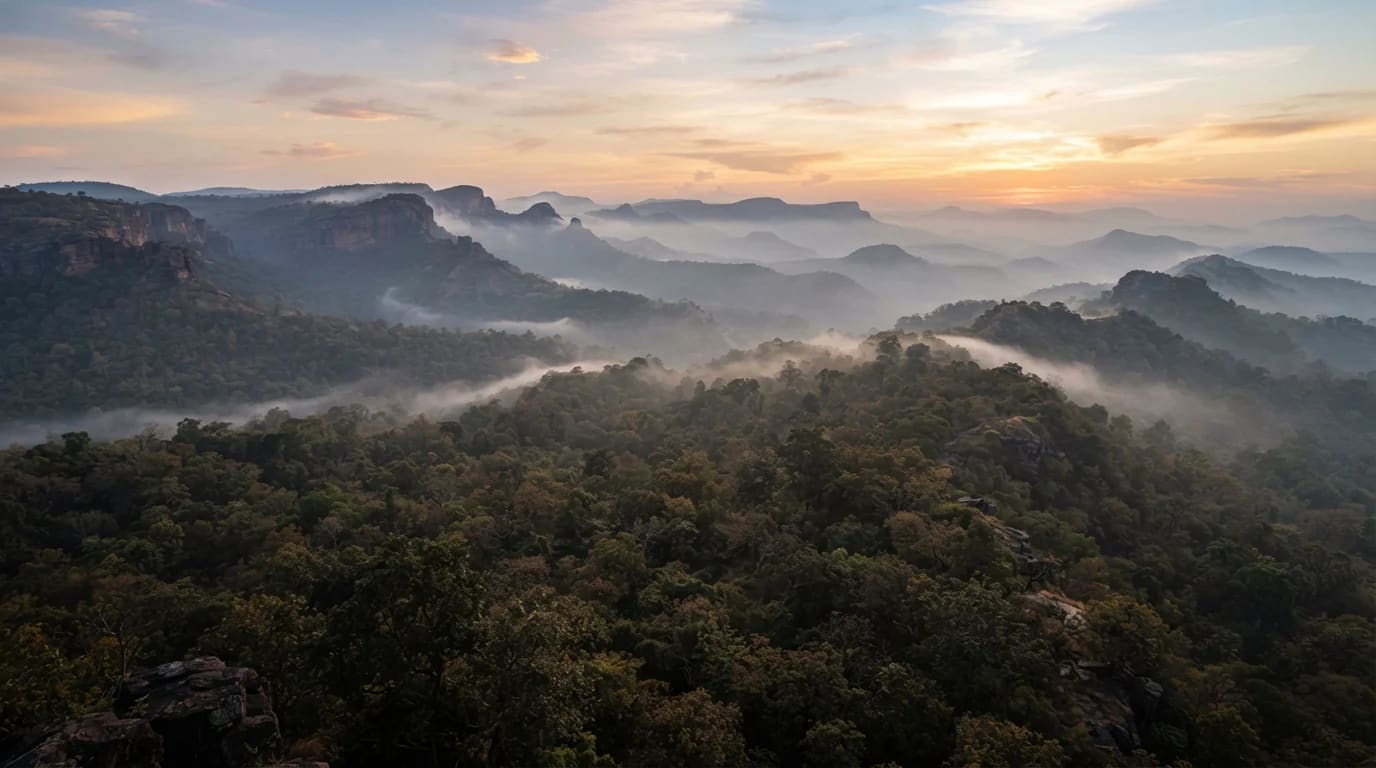
Chronicles of the Vindhyas · Stone Age to today
History of Ratapani: From Bhimbetka to Tiger Reserve
From Stone Age hunters painting the walls of Bhimbetka to Gond forts, Bhopal’s princely forests and a tiger reserve notified in 2024: 100,000 years of people and wildlife in one landscape.
Ratapani history at a glance
Prehistoric continuity
Bhimbetka’s 750+ rock shelters show human life from the Stone Age to the 2nd century BCE (UNESCO, 2003).
Kingdoms and forts
Raja Bhoj’s Bhojpur, Ashokan inscriptions at Saru Maru and the Gond hill fort of Ginnorgarh.
Bhopal State era
The forests south of Bhopal served as princely hunting and timber grounds until 1947.
Modern protection
Wildlife sanctuary in 1976; notified as India’s 57th tiger reserve on 2 December 2024.
Ratapani History Timeline: 100,000 Years
- 100,000+ years ago – 2nd century BCEStone Age to early history
Bhimbetka: the first people of Ratapani
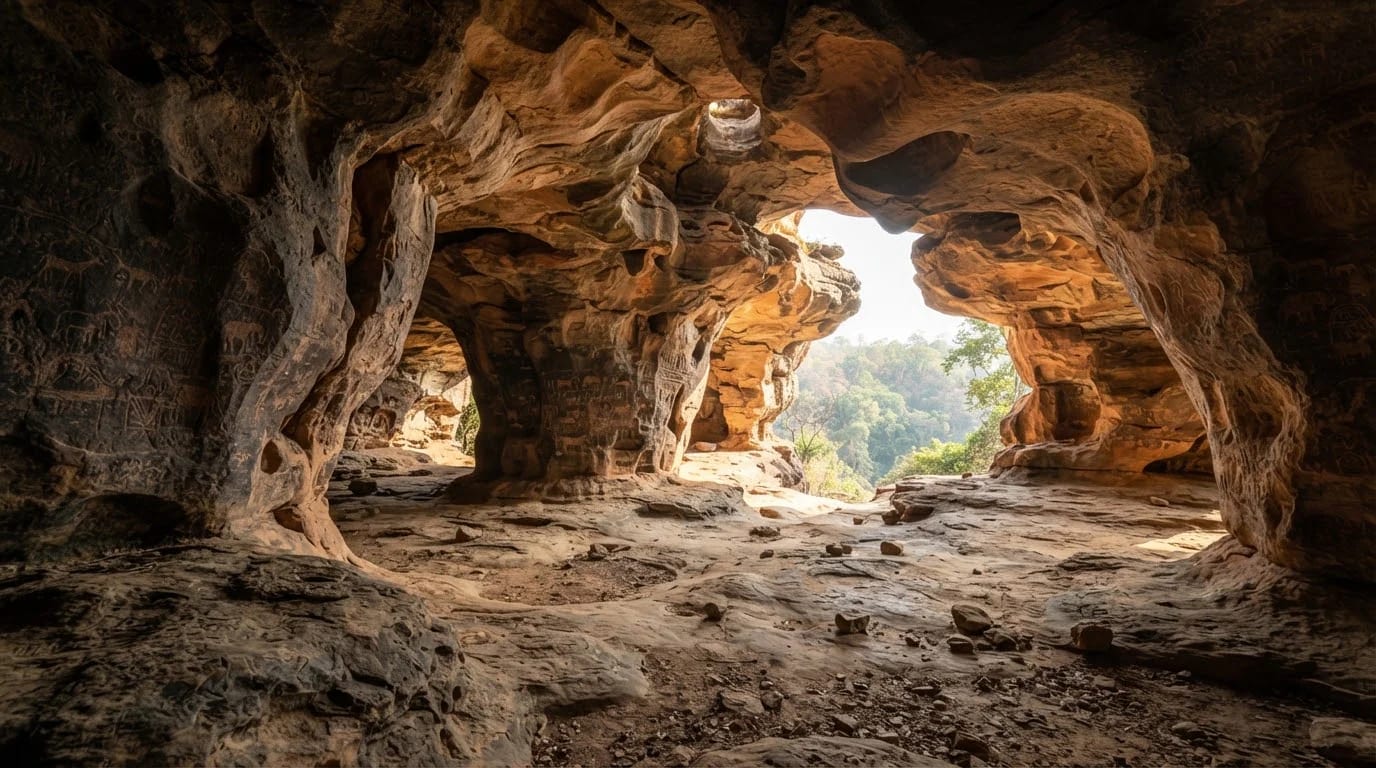
The story of Ratapani begins in its sandstone hills. At Bhimbetka, on the southern edge of the Vindhya range and inside today’s Ratapani forest, more than 750 rock shelters spread over about 10 km show continuous human settlement from the Stone Age (Acheulean period) to around the 2nd century BCE. Some shelters were lived in more than 100,000 years ago.
Around 400 shelters carry paintings in red, white, yellow and green made from natural pigments such as haematite and charcoal. They show hunters with bows and barbed spears, dancers, mothers and children, and animals including deer, bison, boar, rhinoceros and big cats. The earliest paintings are dated to at least 10,000 years ago.
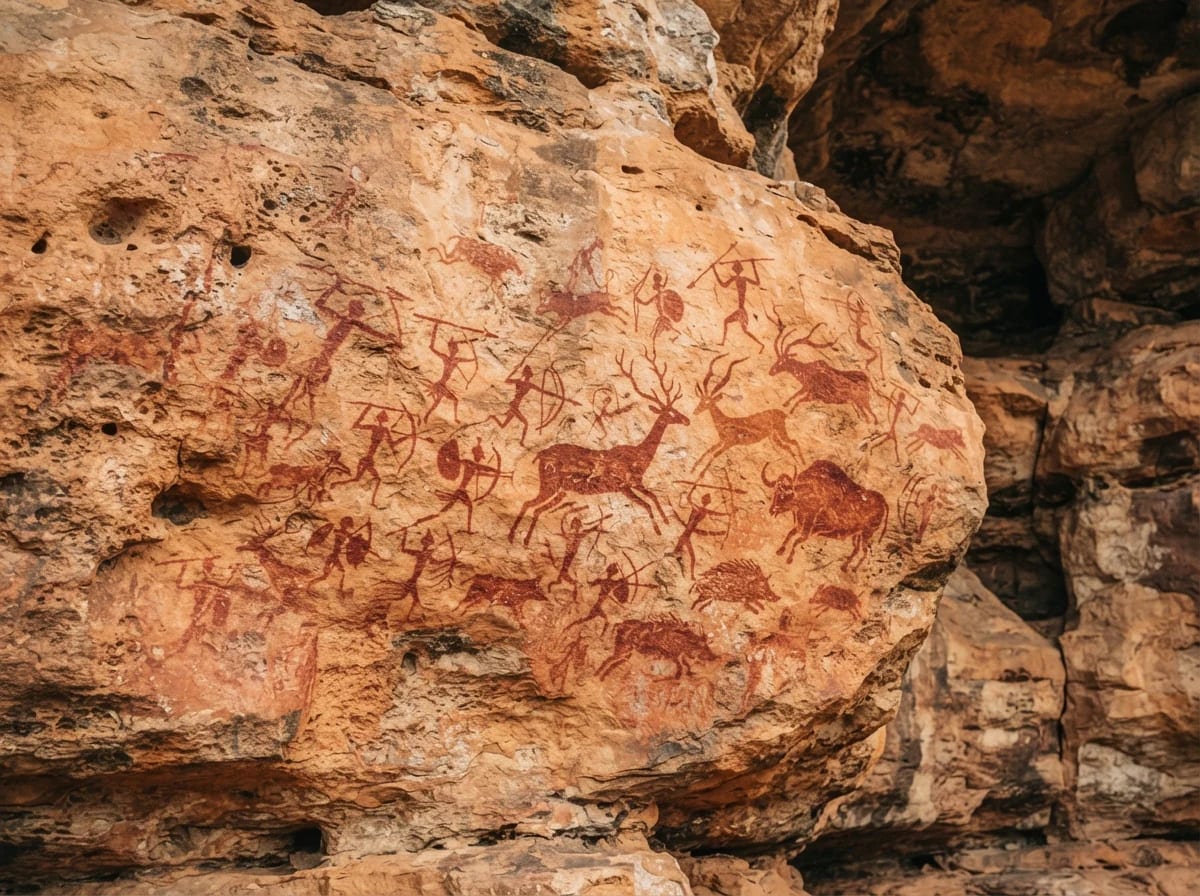
Red ochre rock paintings at Bhimbetka show hunting scenes and the wildlife of the Vindhya hills. - 3rd century BCEMauryan era
Saru Maru and the footsteps of Ashoka
Near Pangoraria village, on the edge of the Ratapani landscape, the Saru Maru caves were a Buddhist monastic site. They carry carved Buddhist symbols and two inscriptions linked to Emperor Ashoka: a Minor Rock Edict and a record of his visit to the area while he was still a prince and viceroy. Old temple remains near Delawadi also point to the region’s long religious history.
- 11th – 18th century CEMedieval kingdoms
Raja Bhoj, Gond rulers and Ginnorgarh Fort
In the 11th century the Paramara king Raja Bhoj of Malwa built the great Shiva temple at Bhojpur, just north of the Ratapani hills. In later centuries these forests fell within the domains of Gond rulers.
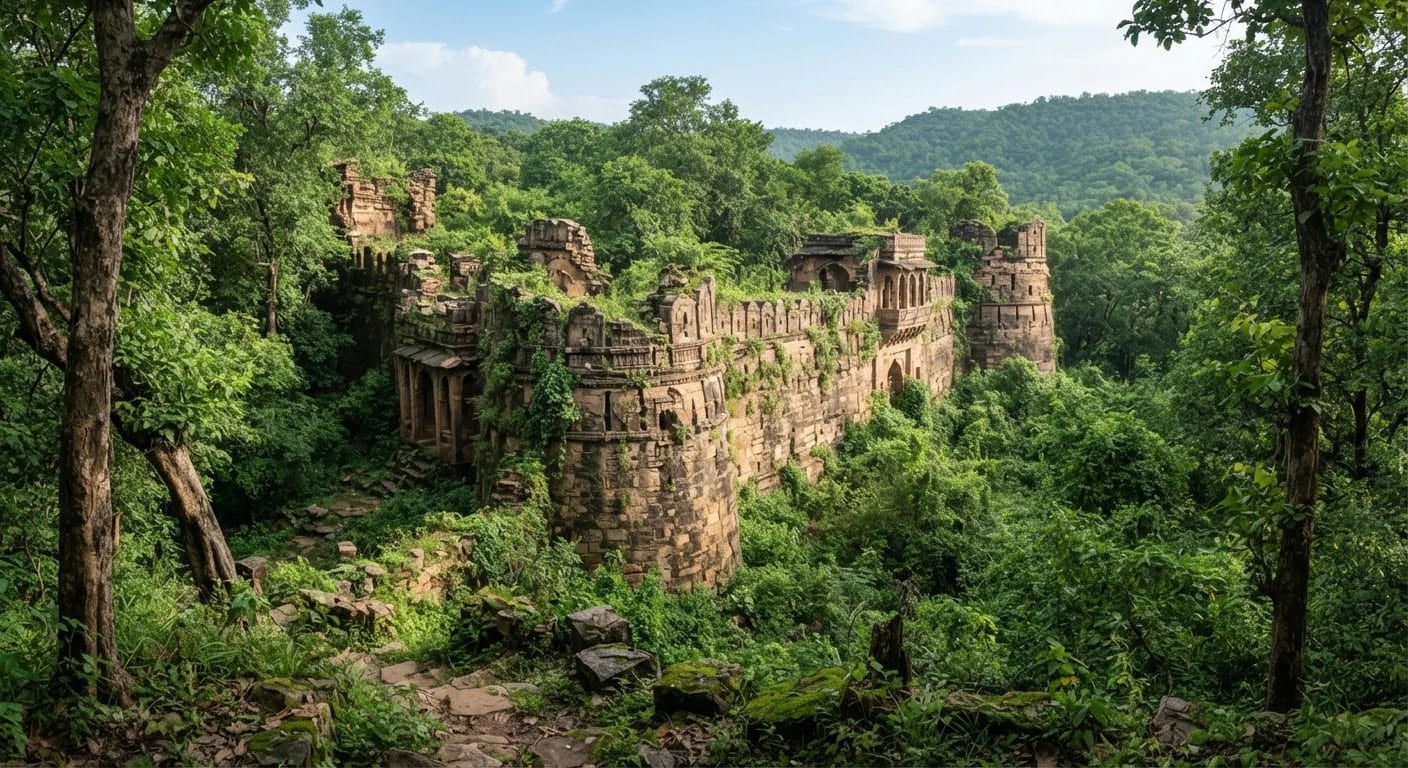
Their most dramatic legacy is Ginnorgarh Fort, built on an isolated hilltop deep in the forest near Delawadi. Local history links it with the Gond king Nizam Shah and Rani Kamlapati, after whom Bhopal’s Rani Kamlapati railway station is named. The fort later passed to Dost Mohammad Khan, founder of Bhopal State. Today Ginnorgarh can only be reached on foot from the Delawadi side and is known for its birdlife.
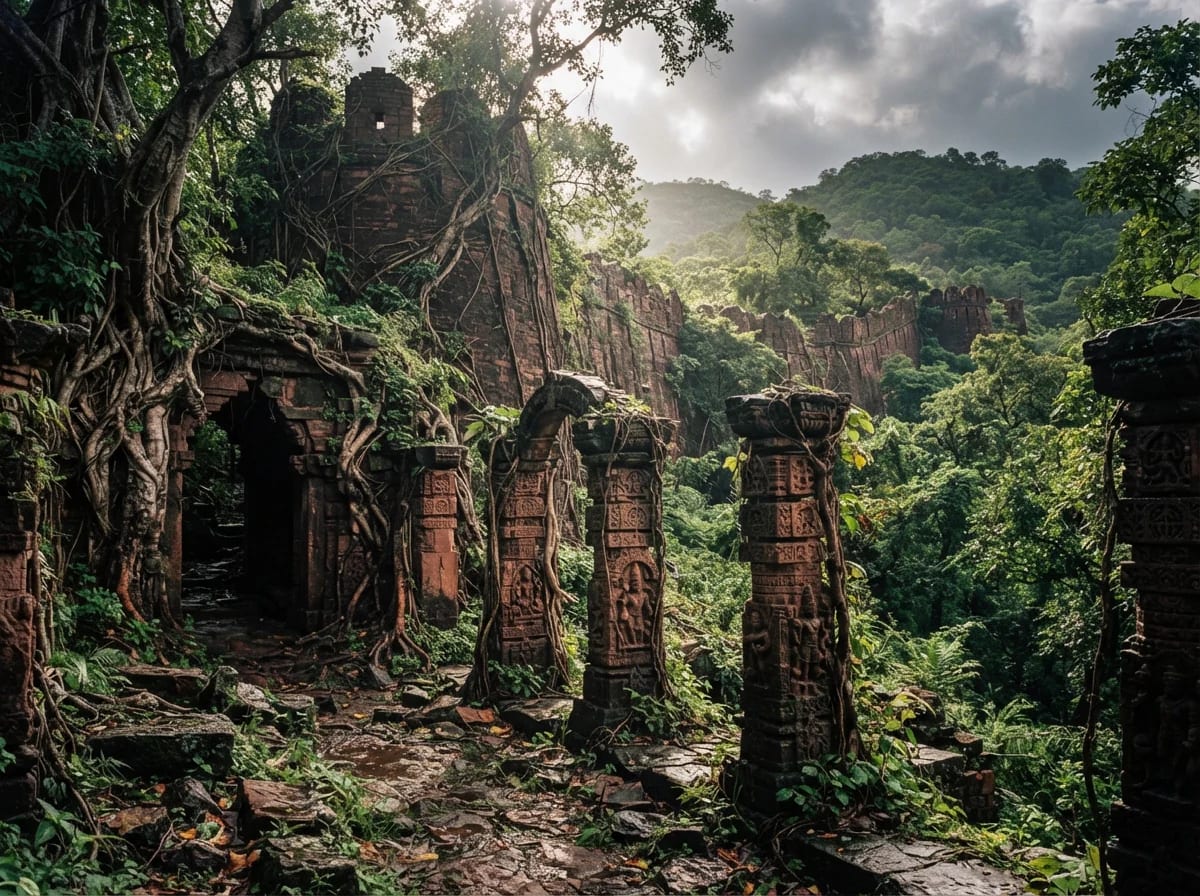
Forest-covered ruins like those around Ginnorgarh are scattered through the Ratapani hills. - 18th century – 1947Bhopal State
Princely forests of Bhopal State
Under the Nawabs and Begums of Bhopal, the hill forests south of the capital supplied timber and served as hunting grounds, as was common across princely Central India. Forest records suggest that hunting pressure on herbivores dates back to this era.
In 1888 the British official W. Kincaid made the first written mention of Bhimbetka, describing it as a Buddhist site. During the Second World War a prisoner-of-war camp was set up in this part of Central India; its remains are still visited by curious travellers.
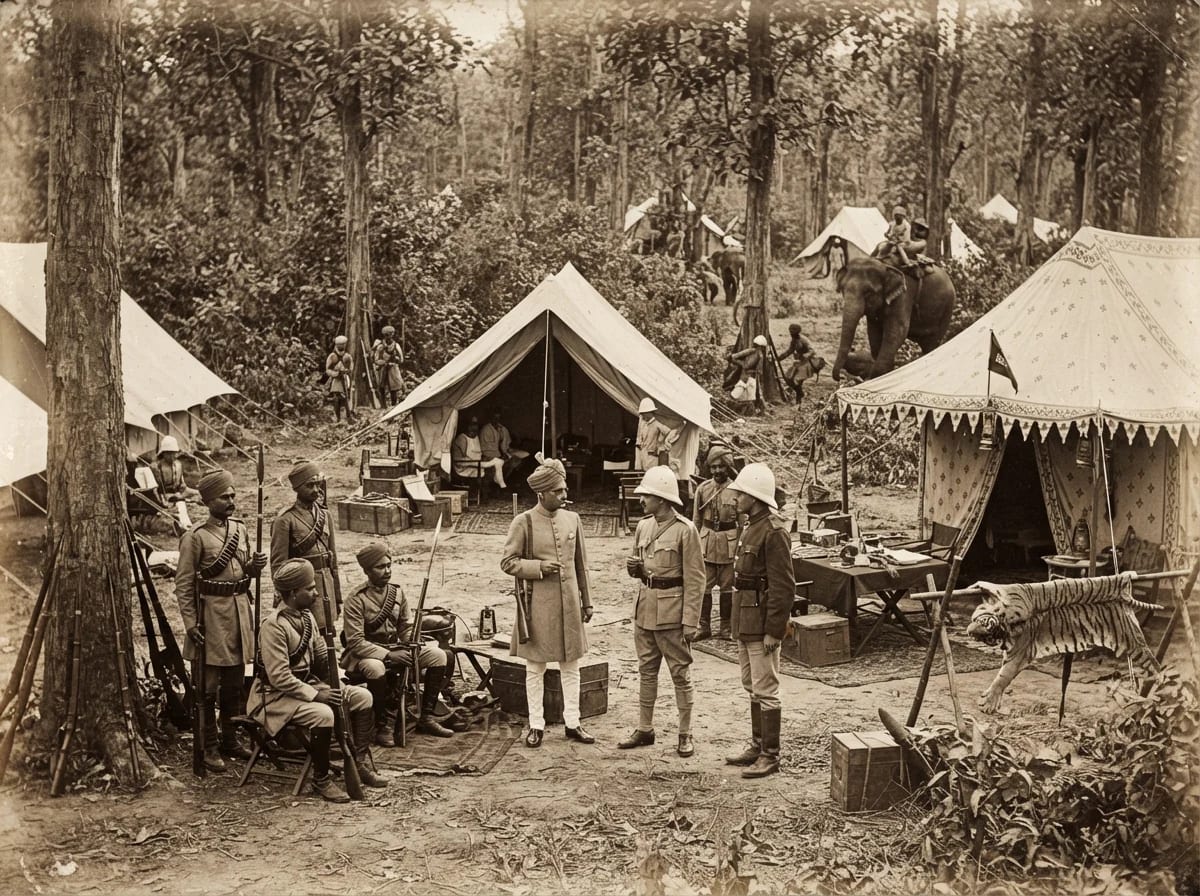
Forest camps were part of life in Central India’s princely-era jungles. - 1957 – 2003Rediscovery
Bhimbetka rediscovered and recognised by UNESCO
In 1957 archaeologist V. S. Wakankar recognised the prehistoric importance of the Bhimbetka shelters after spotting the rock formations on a train journey. Excavations through the 1970s revealed the full scale of the site, and in 2003 the Rock Shelters of Bhimbetka were inscribed as a UNESCO World Heritage Site.
- 1976Legal protection
Ratapani Wildlife Sanctuary is declared
Following India’s Wildlife (Protection) Act of 1972, Ratapani was declared a wildlife sanctuary in 1976. The sanctuary covers about 824 km² of hills, plateaus and valleys in Raisen and Sehore districts, with teak covering roughly 55% of the forest.
≈ 824 km²Wildlife (Protection) Act, 1972
Ratapani Wildlife Sanctuary · Raisen & Sehore
- 2008 – 2024Tiger reserve
From sanctuary to India’s 57th tiger reserve
The National Tiger Conservation Authority (NTCA) gave in-principle approval to make Ratapani a tiger reserve in 2008. After a wait of more than 16 years, the Madhya Pradesh government notified Ratapani Tiger Reserve on 2 December 2024, with a 763.8 km² core and a 507.7 km² buffer: 1,271.5 km² in total.
Ratapani became Madhya Pradesh’s eighth tiger reserve and India’s 57th. Jungle safaris for visitors had already begun in December 2022 from the Jhiri and Delawadi sides, and today tourists enter through three gates: Jhiri, Delawadi and Bhimbetka.
Name & place
What Does the Name “Ratapani” Refer To?
Pani means water in Hindi, and water defines this forest. The sanctuary shares its name with the Ratapani Dam reservoir in the heart of the landscape, one of the two major waterbodies here along with Barna Reservoir.
The reservoirs and the pools left in seasonal streams keep wildlife alive through the dry summer. Officially the area is known as Ratapani Wildlife Sanctuary (since 1976) and Ratapani Tiger Reserve (since 2024); locally many people still simply call it “Ratapani jungle”.
Gond and Adivasi Communities of Ratapani
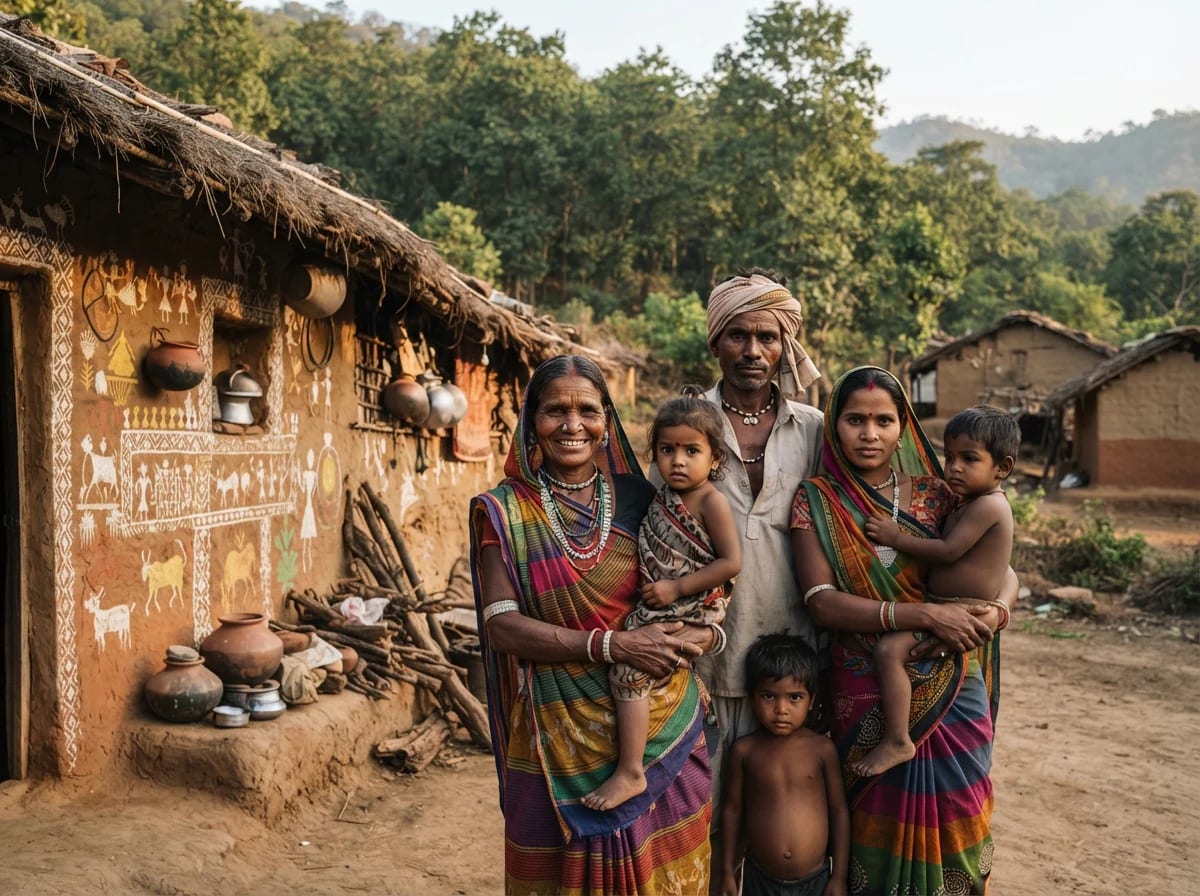
Long before boundaries were drawn, Gond and other Adivasi communities lived in and around these forests, collecting mahua flowers, tendu leaves and firewood and reading the jungle’s signs.
Villages inside and around the reserve
About ten villages lie inside the Ratapani sanctuary and around a hundred surround the reserve. Many families still depend on the forest for daily needs. Under tiger reserve rules the buffer zone supports local livelihoods, while eco-tourism (guides, drivers and safari services) creates new jobs for young people from fringe villages.
Ratapani Wildlife Sanctuary to Tiger Reserve in Numbers
Protected under the Wildlife (Protection) Act, 1972.
MP’s 8th and India’s 57th tiger reserve.
763.8 km² core and 507.7 km² buffer.
Over 70 estimated from pugmarks and other signs.
History of Ratapani: FAQs
When was Ratapani Wildlife Sanctuary established?
When did Ratapani become a tiger reserve?
Is Bhimbetka inside Ratapani?
Who built Ginnorgarh Fort?
How old are the Bhimbetka rock paintings?
More Ratapani travel guides
 Tiger reserve
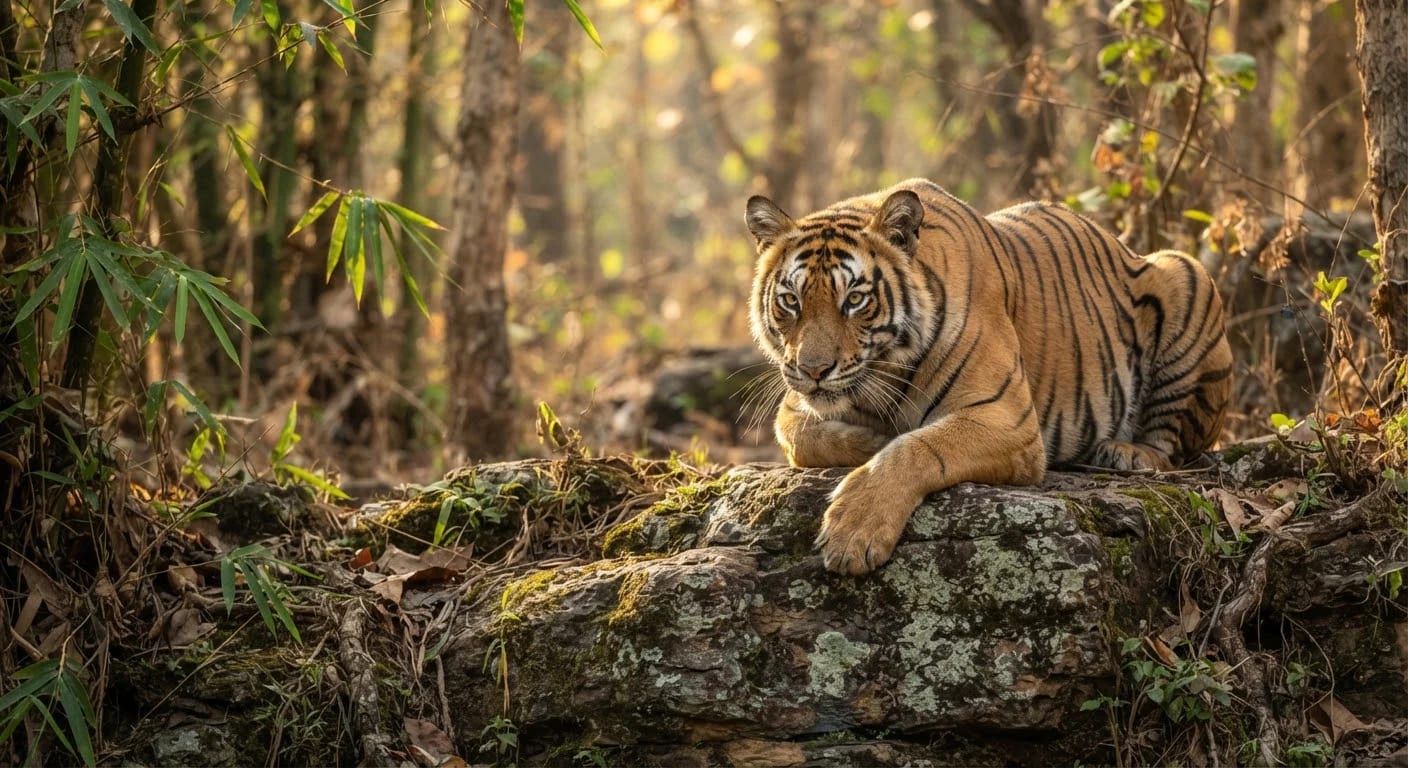
Ratapani Tiger Reserve
Core and buffer zones, tiger numbers, corridors and conservation challenges.
 Gond heritage
Ginnorgarh Fort
Rani Kamlapati’s hill fort, its history and how to visit.
 UNESCO heritage
Bhimbetka Rock Shelters
Painted shelters, periods of rock art, timings and visitor tips.
Sources for this Ratapani guide
- UNESCO World Heritage Centre: Rock Shelters of Bhimbetka
- Mongabay India: Teething troubles at India’s latest tiger reserve (2025)
- MP Tourism: Ratapani Tiger Reserve
- MP Forest Department e-brochure: Ratapani
Safari fees, quotas and timings are set by the Madhya Pradesh Forest Department and can change. Always confirm on the official booking portal before you travel.
Visit Ratapani: Ancient Shelters & Tiger Tracks
Morning and evening safari permits are issued by the Madhya Pradesh Forest Department. Plan your visit with our step-by-step booking guide.